18 · Cold-Climate & Winter Care
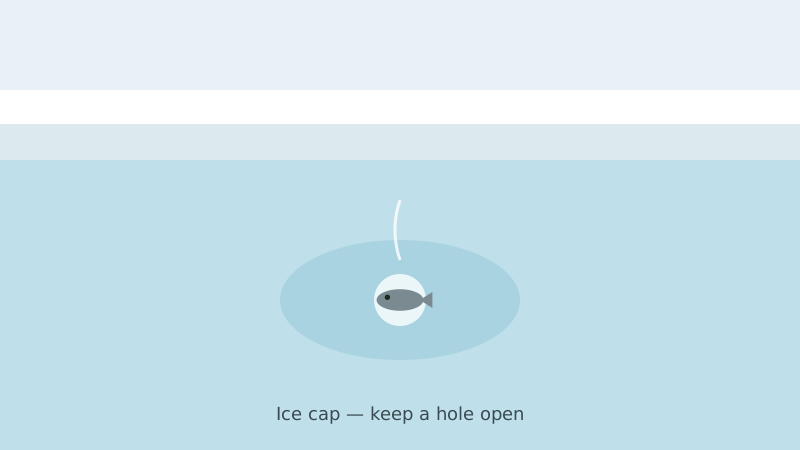
In freezing regions the pond does not shut down — it slows down. Your job is to keep a breathing hole open and avoid shocking the life inside.
Why ice is dangerous
A completely sealed ice cap traps gases from decomposition (CO₂, methane, hydrogen sulfide) under the surface. With no gas exchange, these build to toxic levels and can kill fish and crash bacteria over winter.
Keep a hole open (do NOT smash ice)
- De-icer / heater: a floating thermostatically controlled unit keeps a small melt-hole. Cheap to run and very reliable.
- Air stone / bubbler: moving water resists freezing; keep it near the surface, not deep (deep bubbling can supercool fish).
- Recirculating pump: a small pump pointed upward at the surface can hold a hole in mild cold.
Never
Never strike the ice with a tool or stomp it. The shockwave travels through the water and can rupture fish swim bladders and kill them. If you must clear ice, pour hot water from a pan to melt a hole.
Feeding and fish in winter
- Stop feeding when water drops below ~10°C — fish digestion halts and uneaten food rots into ammonia.
- Fish settle into lethargy in the deepest zone where water stays ~4°C (its densest, most stable temperature).
- Ensure your deep zone is below the local frost line so it never freezes solid.
Plant care
- Hardy lilies and marginals die back; leave stems until spring so nutrients recycle naturally.
- Tropicals will not survive freezing — lift them indoors or compost.
- Net the pond in autumn to keep leaves out (rotting leaves = winter ammonia).
Spring startup
- Remove netting and skim accumulated debris once ice is gone.
- Do a partial water change (10–20%) if the water looks stale.
- Restart the main pump and filtration gradually as temperatures rise.
- Dose beneficial bacteria to re-seed the filter after winter dormancy.
- Begin feeding only once fish are actively swimming and water is > 10°C.
- Divide and replant overcrowded baskets.
Depth rule
Deep zone ≥ frost depth + 20 cm. In a region with 50 cm frost, dig to at least 70–90 cm so life survives beneath the ice.
Winterisation procedure
- Clean filters thoroughly in mid-autumn before shutting down.
- Cut back dead foliage from marginals to 100 mm above water.
- Remove tropical plants or accept they will die.
- Move pump to shallow end or raise it 200 mm off the bottom to avoid pulling in cold sludge.
- Switch to a surface aerator or a pond air pump.
- Install a pond heater or float a tennis ball to keep an ice hole open.
- Reduce feeding to once weekly below 8°C; stop entirely below 4°C.
Never smash ice
The shockwave can kill fish by rupturing their swim bladders. Always keep a hole open preventatively with a heater or floating object.